

Overview
On September 18, 2026, Virginia Governor Abigail D. Spanberger signed Executive Order 22 (“EO 22”). EO 22 establishes the Governor’s Virginia Data Center Accountability Framework and signals a more active state role in how data center projects are evaluated, supported, and developed.
EO 22 is not a statewide data center moratorium. It does not invalidate existing approvals or immediately establish a new permitting regime. Instead, it changes several state-government practices now, directs agencies to develop new tools and potential standards over the next 120 to 240 days, and signals the Governor's broader legislative agenda for 2027.
For developers, the immediate effects are targeted. Projects awaiting local approval should expect greater disclosure, closer review of power and environmental impacts, and more focus on mitigation and community benefits. Projects with final approvals and vested rights are better insulated from EO 22’s immediate effects.
Immediate Changes for New and Pending Projects
- Expect less confidentiality in state dealings. Executive branch entities may not enter into, require, or enforce nondisclosure agreements that prevent public disclosure of material information concerning a proposed commercial data center, including incentives, resource demands, and community impacts. Existing contractual commitments and NDAs are to be honored, but developers should assume that more project information shared with state agencies may become public.
- Confirm access to state development support. VEDP may not assist a new data center project with anticipated peak demand of 25 MW or more through the Virginia Business Ready Sites Program, an expedited permitting program, or a similar discretionary state site-readiness or expedited-review program. The restriction does not bar ordinary local or state approvals, but affected projects may face a slower or less coordinated path.
- Prepare for coordinated state review. The Office of the Chief Energy Officer now leads implementation across the executive branch. Developers should expect greater coordination among agencies on the Framework's priorities, particularly energy infrastructure, water, backup generation, noise, siting, workforce, and community impacts.
Issues Developers Should Begin Planning For
Most of EO 22's data center provisions direct agencies to study, consult, recommend, or begin rulemaking.
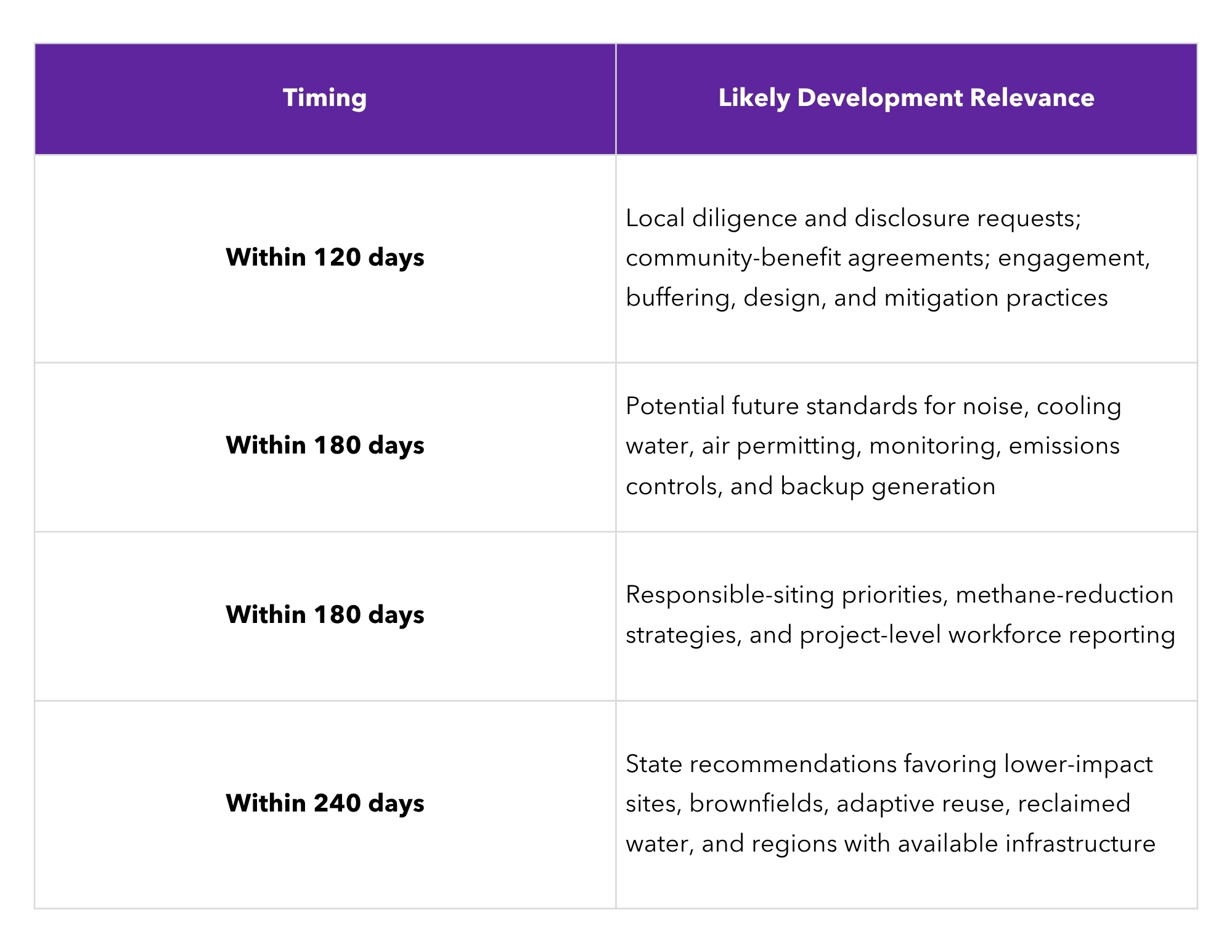
While they are not yet new permit standards, developers should consider them when selecting sites, structuring community engagement, preparing entitlement submissions, and designing projects that will remain under review as the new guidance develops.
2027 Proposals That Could Reshape Development
The Governor's accompanying Data Center Accountability Framework is broader than EO 22. Proposals identified for further executive or legislative action include:
- Entitlement strategy. Eliminating by-right development and requiring local approval for data centers using more than 25 MW, which could add time, conditions, and political risk to future projects.
- Design and permitting. Establishing stronger requirements for energy efficiency, water and land use, backup generation, noise, and cleaner backup power, including potential requirements for existing facilities.
- Project economics and power strategy. Allocating more generation, transmission, and PJM-related costs to data centers and other large-load customers; requiring stronger financial commitments; and adopting operational standards to protect the grid.
- Clean energy and on-site generation. Limiting behind-the-meter natural-gas generation and facilitating data centers' development or procurement of clean power.
- Workforce and procurement. Prioritizing local hiring, workforce training, Virginia businesses, responsible contractor standards, apprenticeships, and project labor agreements where possible.
The scope and application of these proposals will depend on legislation, final regulations, tariffs, or other valid agency action.
What This Means for the Current Project Pipeline
- Approved projects. EO 22 does not expressly revoke, reopen, or require retroactive review of existing land-use approvals or permits. Projects with final approvals, therefore, are not immediately affected. However, issues may arise if an approval is not vested or the project requires an extension, amendment, revised site plan, permit modification, additional state approval, or discretionary state assistance.
- Pending projects. The clearest immediate effect is the loss of specified VEDP and expedited-review assistance for qualifying new projects at or above 25 MW. Otherwise, existing ordinances and permitting requirements continue to govern unless and until new law or regulations take effect. Projects still under review should nevertheless expect increased scrutiny of power, water, noise, backup generation, traffic, buffering, mitigation, workforce benefits, and community impacts.
- Local zoning and political risk. EO 22 does not itself expand local zoning authority or create new local approval standards. Localities may, however, invoke EO 22 and the Framework’s policy priorities when exercising existing discretion. Discretionary zoning proceedings may, therefore, face additional information requests, mitigation demands, conditions, or pressure for proffers, subject to existing statutory and constitutional limits.
- Near-term developer priorities. Developers should confirm approval and vesting status, identify upcoming expirations and discretionary actions, assess reliance on state programs, and prepare project-specific support on energy demand, water, noise, backup generation, buffering, traffic, workforce benefits, and community mitigation.
We are closely monitoring implementation of EO 22 and related developments affecting data center development in Virginia. If you have questions about how EO 22 or forthcoming changes may affect a specific project or investment, please contact your regular member of our team.
Jeffrey P. Geiger focuses his practice on land use and commercial real estate matters. He assists developers, businesses, institutions and landowners in obtaining zoning and land use approvals throughout Central Virginia and other jurisdictions. Jeff also advises clients on commercial real estate transactions, including deal structure, contract negotiations, development and redevelopment, financing, sales and leasing.
Charles W. Payne, Jr., a native of the Fredericksburg area, prides himself on the business development services he provides to the region. His practice areas include corporate and general business law, zoning and land use, commercial real estate, and federal and state government relations. He routinely represents businesses of all sizes, commercial real estate developers, contractors, not-for-profit foundations, cooperatives, medical practitioners and economic development authorities. Charlie currently serves as general counsel for Rappahannock Electric Cooperative, the largest Virginia electric utility cooperative and one of the largest utility cooperatives in the country.
Matthew G. Roberts is an experienced commercial real estate attorney whose practice focuses on land use and zoning, real estate transactions, public utilities and local government law. He represents developers and property owners in zoning and entitlement matters throughout Virginia, including mixed-use, residential, office, industrial and solar projects. Matt also advises clients on real estate acquisitions and sales, easements, development agreements and site plan and subdivision matters.
Tristan M. Smith is an associate in Hirschler’s business section. His practice focuses on corporate transactions, including mergers and acquisitions, as well as energy and infrastructure matters. He also tracks and analyzes legislative and regulatory developments affecting clients in the energy sector.
Media Contact
Selena A. Browne
804.771.5637
sbrowne@hirschlerlaw.com